
Air-core inductors: when the best core is no core at all
Most inductors get their magnetism a boost: wind the coil around ferrite or iron and the same turns produce far more inductance. So why would anyone leave the core out? Because everything a core adds, it also complicates. The air-core inductor, a coil wound around nothing at all, trades raw inductance for a set of properties no magnetic material can match.
What the core takes away
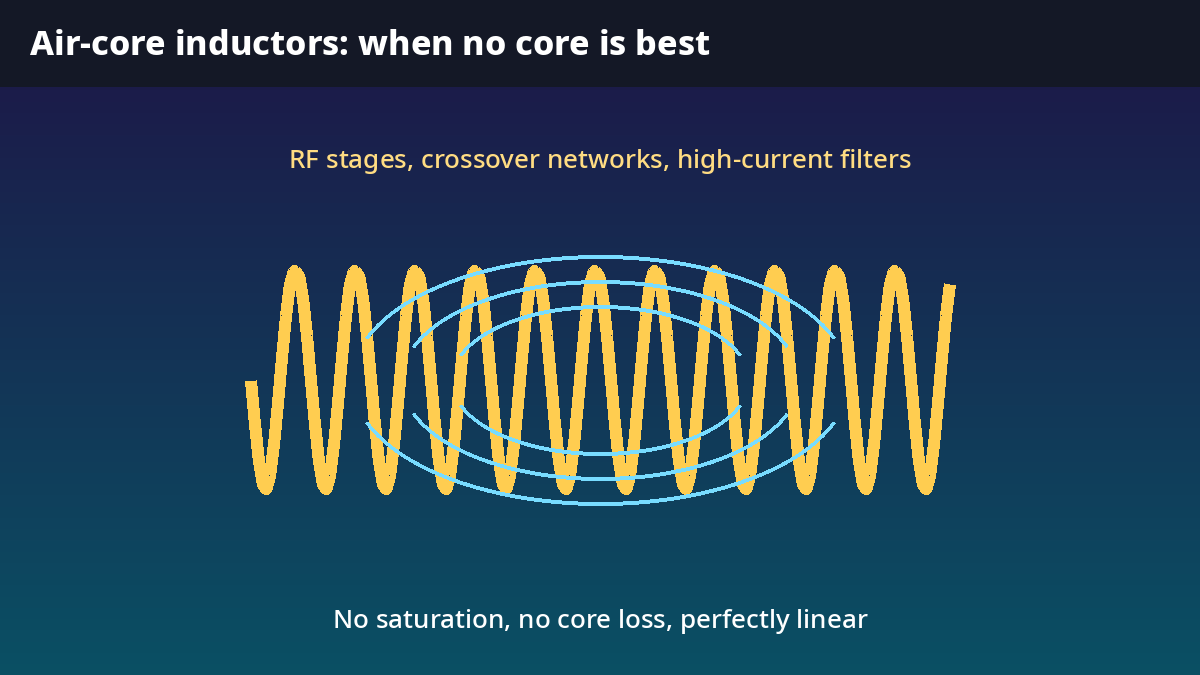
Every magnetic core material has a saturation ceiling: push the field far enough and the material stops multiplying it, and inductance collapses exactly when current is highest. Cores also dissipate energy through hysteresis and eddy currents, losses that grow with frequency. They age with temperature, drift with it too, and introduce distortion because permeability is not constant over the signal cycle. An air core has none of this. It cannot saturate at any practical current, has no core loss and no hysteresis, and its inductance is set by geometry alone: turns, diameter, length. That makes it linear, predictable and stable.
The radio-frequency home
At radio frequencies the balance tips decisively toward air. Above a few megahertz most core materials become lossy, while a well-wound air coil with thick wire or litz keeps a high quality factor. Antenna matching networks, RF amplifier tank circuits, transmitter filters and MRI radio-frequency coils are air-core territory. Geometry is the whole design, so these coils are often wound with deliberate spacing between turns and held by their own stiffness or a minimal former.
High current without saturation
The other natural habitat is high current. Induction heating coils, which push hundreds of amperes at tens or hundreds of kilohertz through a work coil, would saturate any core instantly; they are air-core by necessity, usually water-cooled copper tube. Test coils for surge and impulse work, current-limiting reactors in some power applications, and the voice coils of loudspeakers all rely on the same immunity to saturation.
The price in copper
The cost is turns. Without a core's multiplication, reaching even modest inductance takes many turns, which means more wire, more resistance and a bigger part. Air coils also spray their field around: with no core to guide the flux, the stray field couples into neighbouring components, so layout and shielding matter. Crossover networks in loudspeakers, a classic air-core application, routinely orient coils at right angles to minimise mutual coupling.
Choosing nothing on purpose
The air-core inductor is a reminder that a component's material stack is a set of compromises, not a free upgrade. When the frequency is high, the current is large, or the signal must stay undistorted, the best magnetic material is the one that is not there.