
Current transformers: measuring hundreds of amps without touching them
Somewhere in every switchboard, substation and clamp meter is a ring of steel with a coil on it, quietly reading the current in a cable it never touches. The current transformer, universally abbreviated CT, is the electrical industry's way of shrinking a lethal, unwieldy current into a small, standardised, safe one.
The one-turn primary
A CT is a transformer with an unusual arrangement: the conductor being measured is the primary, passing once through the centre of a toroidal core. The secondary is a winding of many turns on that core, connected to a meter or relay. Current in the cable drives flux around the core, and the secondary current settles so that its ampere-turns balance the primary's. With, say, 400 turns on the secondary, a 400-amp primary produces a clean 1-amp secondary signal: the 400:1 ratio does the scaling, and the instrument on the far side never sees more than a few amps or volts.
Clamp meters are the portable version: the core hinges open so the jaws can close around a cable, and the display reads the ratio-scaled result. Solid-core CTs are bolted in permanently around busbars; split-core versions retrofit onto live panels without disconnecting anything.
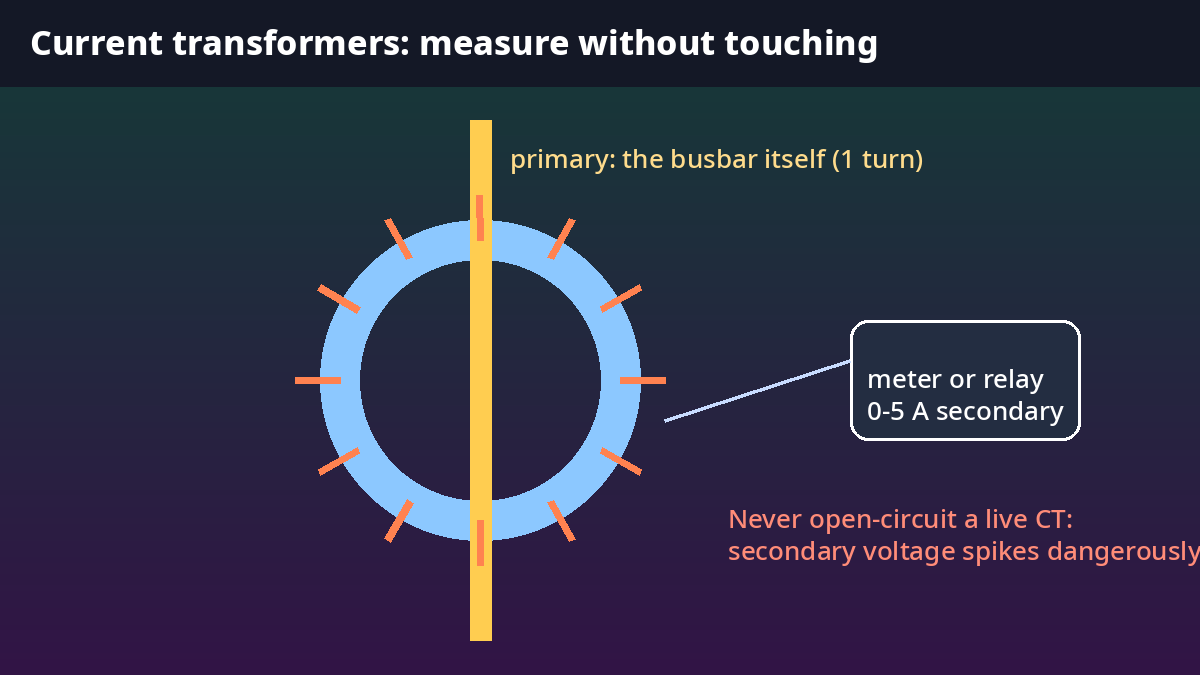
The rule everyone learns once
A CT is the one transformer you must never run open-circuit. An ordinary voltage transformer wants its secondary unloaded; a CT wants its shorted. If the secondary circuit opens while current flows in the primary, nothing balances the primary ampere-turns, the core drives hard into saturation, and the open secondary terminals can produce kilovolt-level spikes: enough to puncture insulation, shock a technician and wreck the CT. Panels are wired so the secondary is shorted before the meter is ever disconnected.
Accuracy is a specification
CTs come in accuracy classes because two different jobs want different behaviour. Metering CTs are precise through the normal load range, feeding the energy meters that bill customers; they are allowed to saturate in a fault, which conveniently protects the instruments. Protection CTs are built the other way: less concerned with fractions of a percent at normal load, but required to keep reproducing the waveform faithfully at ten or twenty times rated current so that protection relays see the fault clearly. Burden, the total load connected to the secondary, is part of the specification, since too much burden drags a CT out of its class.
Everywhere current matters
Beyond billing and protection, CTs feed energy-management dashboards, motor protection units, residual-current monitors and demand controllers. They isolate, they scale, and they do it with no electrical contact and no power supply of their own. For a component that is only a ring core and a winding, that is a remarkable amount of leverage: the humblest coil in the substation, and the one the whole metering chain trusts.