
The flyback transformer: the hardest-working little coil in electronics
Take the charger out of your pocket and you are holding a transformer that is not, strictly speaking, a transformer. The flyback transformer inside a phone charger, a set-top box or a TV standby supply is more accurately a coupled inductor: a component that stores energy in a magnetic field and then hands it across an isolation barrier, tens of thousands of times per second. It is one of the highest-volume wound components on Earth.
Store, then deliver
A conventional mains transformer transfers energy continuously: primary and secondary conduct at the same time and the core only carries the magnetising field. A flyback works in two phases. While the switch (a transistor) is on, current builds in the primary winding and energy accumulates in the core's magnetic field; the secondary diode is reverse-biased, so nothing flows to the output. When the switch turns off, the field collapses, the voltage polarities flip, the diode conducts, and the stored energy discharges into the output capacitor and load. The name comes from the way the energy "flies back" out of the core.
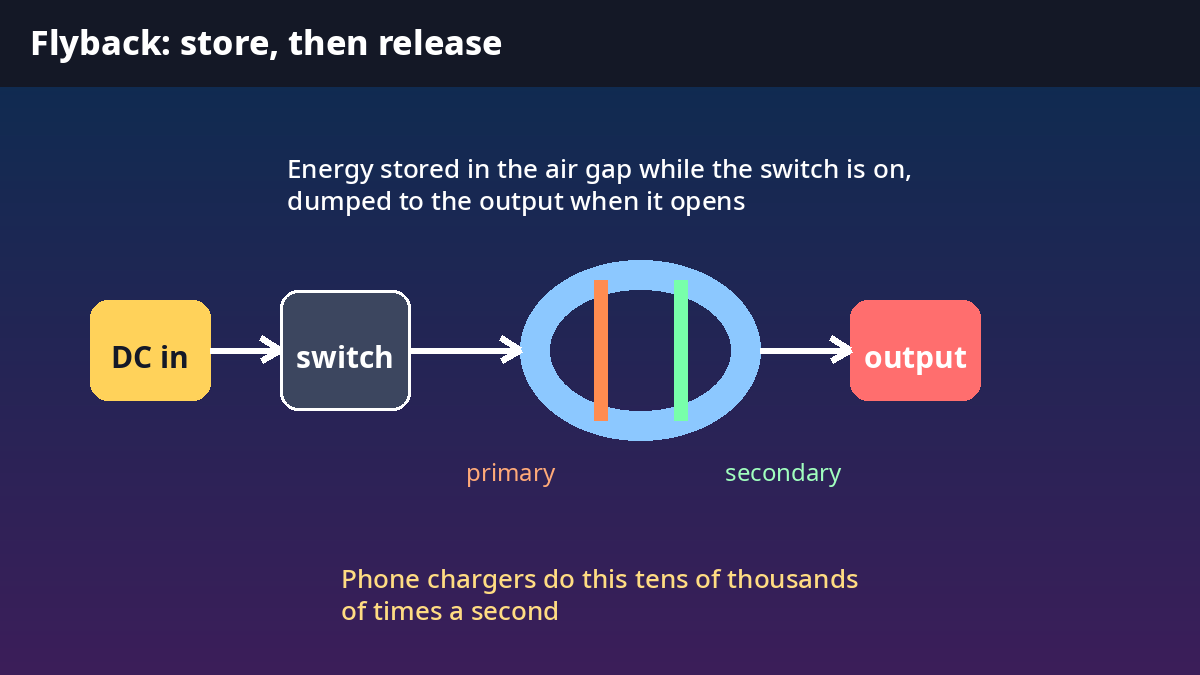
The deliberate gap
The core of a flyback has a small, deliberate air gap, ground into the centre limb or distributed through the material. A gap looks like a defect, but it is the energy store: magnetic energy concentrates where reluctance is highest, and the gap dominates the reluctance. Sizing the gap sets how much energy each cycle can carry without saturating the core, which is why flyback design sheets spend so much attention on fractions of a millimetre.
Why it won the small-power world
The flyback's advantages are economy and flexibility. One magnetic component provides isolation, voltage transformation and energy storage, with only one diode and one capacitor per output. Extra secondaries are just extra windings, so a single supply can produce several voltages. The circuit tolerates very wide input ranges, which is why the same charger architecture runs on 100 to 240 volts worldwide. For power levels from a few watts up to roughly a hundred, nothing else is as cheap.
The compromises
The two-phase operation has a cost. Current flows in pulses rather than smoothly, so peak currents and losses run higher than in comparable forward converters, and the output ripple needs more filtering. The leakage inductance between primary and secondary rings at every switch-off, producing a voltage spike that must be snubbed or clamped. And because energy rides on a collapsing field, control loops must handle the topology's right-half-plane zero, a quirk that makes regulation design subtler. Above a few hundred watts, other topologies take over.
A winding-shop component
For coil winders, the flyback is a demanding product: interleaved primary and secondary layers to control leakage, reinforced insulation for safety isolation, often triple-insulated wire to meet creepage rules without tapes, and tightly held inductance tolerances. Small, cheap, everywhere, and anything but simple.