
How transformer coils are wound: the machines behind distribution and power transformers
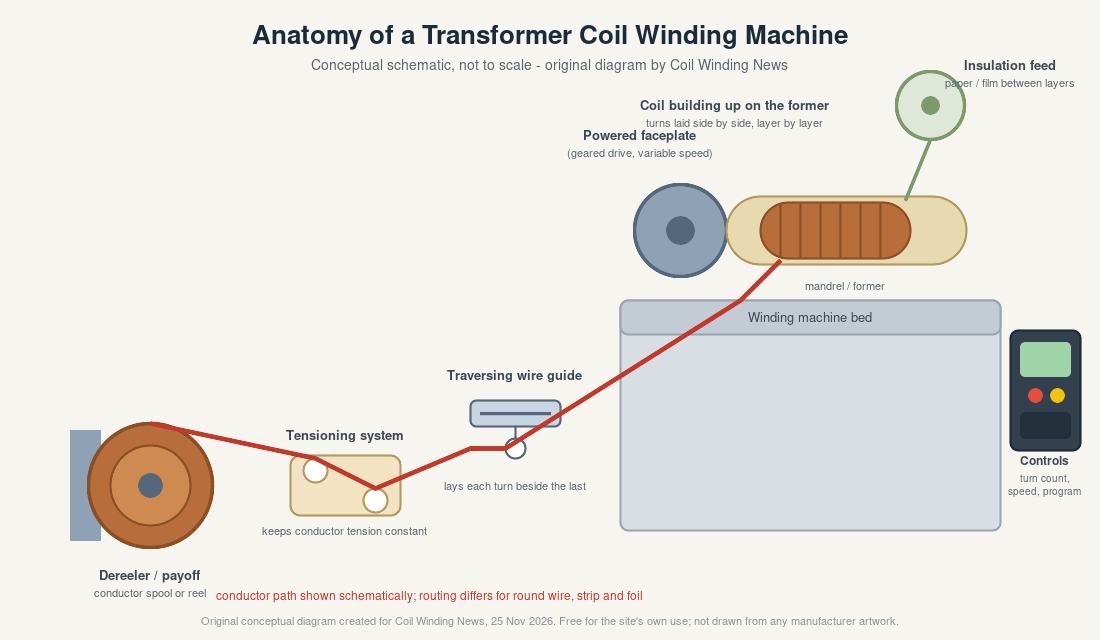
Transformers come in many designs, but many of them share one manufacturing step: insulated conductor has to be wound into coils that are electrically precise, mechanically tight and insulated between turns and layers. That work is done on transformer winding machines, a branch of coil winding equipment with its own machine types and its own specialist builders.
This article looks at two common coil constructions, layer-wound high-voltage coils and foil-wound low-voltage coils, and at what the machines that wind them do. It draws on what winding machine makers say on their own websites, including companies from our guide to who builds coil winding machines.
Two common constructions, two machine types
A conventional two-winding transformer has a high-voltage (HV) winding and a low-voltage (LV) winding. In many distribution and power transformer designs they are made differently, on different machines. The two constructions below are common examples, not a universal design. Real transformers also use disc windings, helical windings, strip-wound coils and others.
Layer-wound HV coils. Many high-voltage coils are layer-wound: turn after turn of insulated round conductor laid side by side along a rotating former, with sheet insulation placed between layers. The machine keeps conductor tension steady, guides the wire so each turn sits against the last, and feeds the inter-layer insulation. How much of this is automated varies by machine. For one example, Trishul Winding Solutions of Bengaluru describes an automatic HV coil winding machine for high-voltage transformer coils, with progressive inter-layer insulation and automatic cut-and-feed attachments.
Foil-wound LV coils. Many low-voltage windings use a wide strip of copper or aluminium foil instead of round wire, with insulating film or paper wound in alongside the conductor. Foil winding is a specialty of its own. Calotron in Hamm, Germany, describes foil and band winding machines for transformer and choke construction. Trishul lists a programmable foil winding machine for low-voltage coils with foil conductors, inter-layer insulation and end-fill support.
Why tension control matters
Whatever the construction, conductor tension is one of the basic things a winding machine has to control. A coil wound too loosely can shift in handling and service. A conductor pulled too tight can stretch or damage its insulation. Winding machines therefore include tensioning equipment and guides that place each turn where the program intends. For foil, edge guiding keeps successive wraps aligned.
From compact winders to horizontal machines
Transformer winding equipment covers a wide range. At one end are compact, programmable winders for small coils. At the other are horizontal winding machines for large coils. Formertron Engineering of Navi Mumbai says it specializes in horizontal winding machines for coils from distribution transformers to UHV power transformers, and it also lists core stacking tables and core-and-coil assembly workstations. Broomfield USA in Massachusetts describes coil and transformer winding machines, plus wire dereeling and flattening equipment.
Other makers cover transformers within wider ranges. Heinrich Schümann of Lübeck, Germany, says it makes machines for motors, generators and transformers. Whitelegg (Herne Bay, UK) lists transformers among the applications for its winding equipment, and Winding Technology (Huddersfield, UK) says it supplies the coil, motor and transformer industries. In India, Synthesis Winding Technologies lists transformer, capacitor and film-foil winding machines, and Transwind Technologies offers custom-built winding machines.
What this means for buyers
For a transformer maker, choosing between a manual winder, a programmable machine and a more automated line depends on coil design, volume and staff experience. The coil is the heart of the transformer, and the machine that wound it affects how consistent that coil is. Start with the coil you need to wind, then ask a maker for details of the machine and a sample.
Capabilities are as described on each manufacturer's own website, checked on 25 November 2026. The constructions described are common examples, not a full account of transformer design. This is not a product endorsement or ranking. Sources: the company links above. The header diagram is a conceptual schematic, not to scale, created for Coil Winding News; conductor routing differs for round wire, strip and foil.