
Ignition coils: twelve volts in, twenty thousand volts out
A petrol engine needs one electrical event to happen with absolute reliability, millions of times: a spark hot enough to ignite the fuel mixture, inside a cylinder, at a precise millisecond. The component that makes a car battery's modest twelve volts equal to that task is a coil, the ignition coil, and it is one of the hardest-working small transformers ever wound.
A transformer that works in pulses
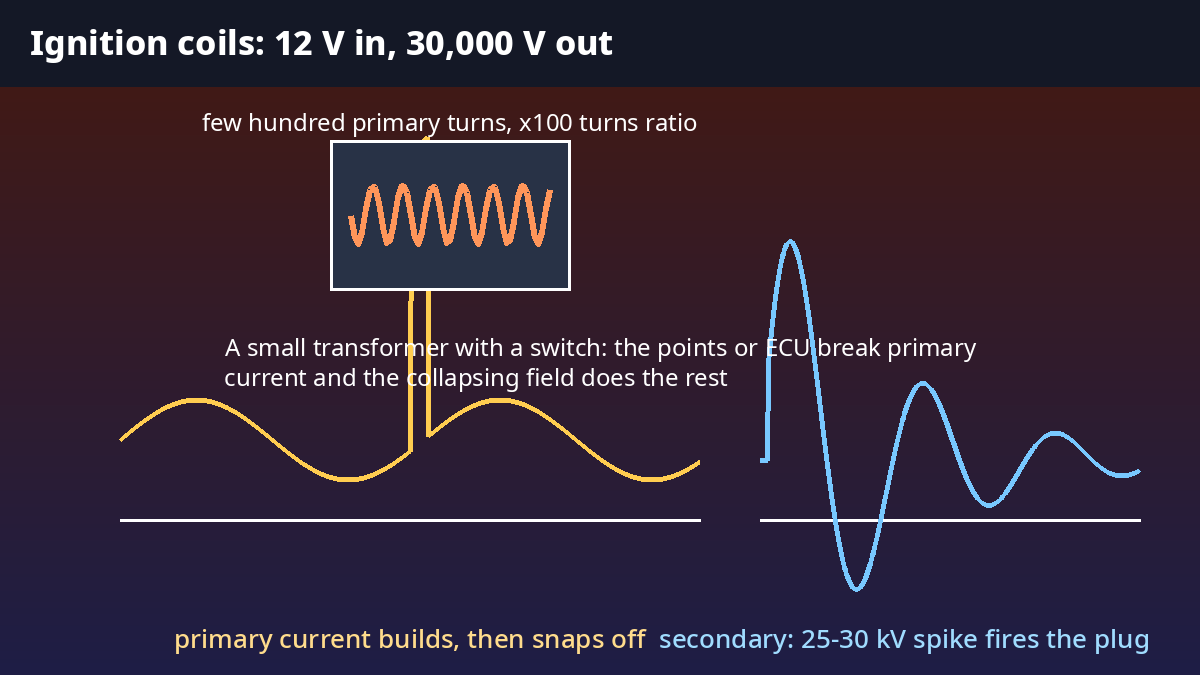
An ignition coil is a step-up transformer operated in a way mains transformers would find abusive. The primary is a few hundred turns of relatively thick wire; the secondary is tens of thousands of turns of wire finer than hair, a turns ratio around one to one hundred. With the primary circuit closed, battery current builds a magnetic field in the laminated iron core. At the firing instant the engine controller opens the primary circuit, once a mechanical contact, now a transistor, and the current stops abruptly. The collapsing field induces a high voltage in both windings, and in the secondary, with its hundredfold turns advantage, that voltage climbs until something conducts: the spark plug gap, at typically 20,000 volts or more.
Why the winding is the hard part
The secondary of an ignition coil is a winding-shop showcase: tens of thousands of turns of wire around a twentieth of a millimetre thick, layered with insulating film so that adjacent layers, which see kilovolts of difference, do not break down. The coil must survive its own output, vibration, under-bonnet heat cycling from winter cold to well past boiling, and decades of pulses. Encapsulation in epoxy keeps moisture and vibration out; the laminated core, sized like a finger, keeps the pulse fast and efficient.
From one coil to coil-on-plug
Classic engines shared a single coil, with a distributor switching the spark between cylinders. Wasted-spark systems doubled the frequency by firing paired cylinders. Modern engines place a pencil coil on each plug, fired in precise sequence by the engine computer. The per-cylinder architecture demands more of the winding, since each coil now lives directly atop a hot, vibrating plug, and rewards it with better timing control and no high-voltage distribution losses.
Reading a tired coil
Ignition coils wear in characteristic ways. Enamel fatigue in the secondary shows up as misfires under load, when cylinder pressure is highest and the plug needs the most voltage. Cracked insulation tracks to the housing, visible as carbon lines. Primary resistance drift changes the charge time. A scope pattern of the firing and burn voltages reads the coil's health cylinder by cylinder, which is why ignition waveforms remain a diagnostic staple decades after the oscilloscope first met the motor car.
The specialist transformer
Most transformers are designed to transfer energy continuously and efficiently. The ignition coil is designed to store energy, then deliver it all in one violent microsecond, at a voltage that would frighten the average mains unit. As petrol engines gradually yield to electric drivetrains, the winding skills it perfected, fine wire, high ratio, brutal insulation stress, transfer intact to the onboard chargers and drive motors taking its place.