
Class B, F or H: what the insulation letters on a motor nameplate really mean
Somewhere on the nameplate of almost every industrial motor is a small letter: B, F or H. It is not a quality grade or an efficiency mark. It is the thermal class of the winding insulation, defined by the international standard IEC 60085, and it states the maximum temperature the insulation system can withstand continuously while still delivering a normal service life. Understanding those few letters explains a great deal about how motors are specified and why they fail.
The classes and their numbers
IEC 60085 assigns each thermal class a letter and a rated temperature, read as the hottest spot the insulation system is designed to run at continuously, not an average or a surface reading. The everyday classes are A at 105 degrees C, E at 120, B at 130, F at 155 and H at 180, with further classes above for specialist work. The temperature is the hottest point anywhere in the insulation system, not the average and not the surface of the housing. The rating is tied to endurance: the class temperature is the level at which the insulation is expected to survive on the order of 20,000 hours of continuous operation, roughly two to three years of non-stop running, before its dielectric and mechanical strength decay beyond usefulness.
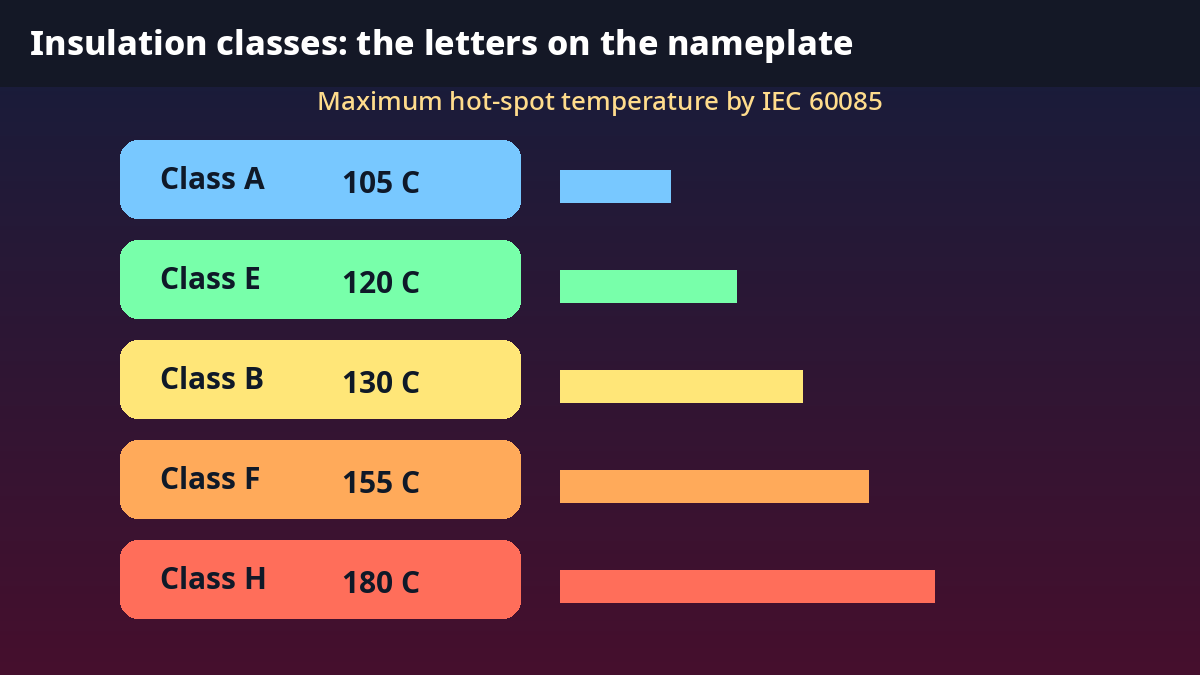
Heat is the aging agent
Enamel films, slot liners, tapes and impregnating resins are organic materials, and heat drives the chemistry that ages them: oxidation, loss of plasticisers, embrittlement. The widely used rule of thumb is that insulation life roughly halves for every 10 degrees C above its rated hot-spot temperature. A winding designed for class F but habitually run 20 degrees hot is not slightly worse off; it is living its life at four times the intended speed. This is why ventilation, blocked filters and chronic overload show up so often in post-mortems of burnt windings, as covered in our guide to wire insulation.
What the class covers
The rating applies to the whole insulation system, not one material. Magnet wire enamel, phase paper, slot wedges, lead wire sleeving, tie cords and the varnish or resin that binds it all must each carry their part of the temperature budget. Wire enamel chemistries map roughly onto the classes: polyurethane and modified polyester enamels serve the lower classes, polyesterimide covers class F territory, and polyamide-imide or polyimide films reach class H and beyond.
Why nameplates often show a reserve
A common specification is class F insulation with class B temperature rise: the insulation is rated for 155 degrees C hot-spot, but the motor's guaranteed temperature rise keeps the actual winding comfortably inside the lower class B envelope. The difference is deliberate headroom for hot days, high altitude, dirty cooling fins and occasional overload. When a datasheet offers class H, it is often buying that margin for harsh duty rather than inviting the owner to run hotter.
The practical reading
For buyers and maintainers the letter translates into three questions. What ambient temperature and duty cycle is the machine rated for? How much thermal margin sits between the guaranteed rise and the class limit? And does the rewind shop, when the time comes, restore the same class with equivalent enamel, paper and resin? A motor that left the factory as class F and comes back from repair as something less has had its nameplate quietly rewritten.