
Linear motors: the rotary motor, unrolled
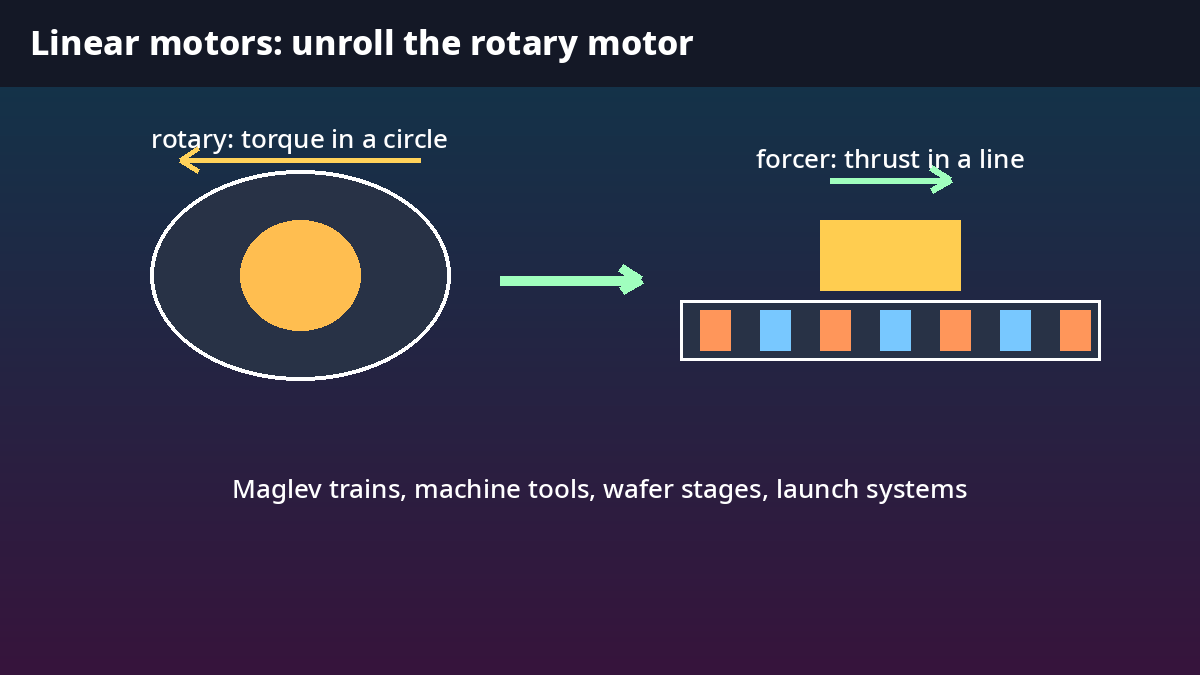
Every conventional motor delivers rotation, and most machines then spend gears, belts or ballscrews converting that rotation into straight-line motion. Each conversion adds play, wear, friction and a maintenance schedule. The linear motor declines the whole chain: it produces thrust in a straight line directly, and its construction is exactly what the name suggests, a rotary motor cut open and rolled flat.
Unrolling the machine
Picture a rotary induction or synchronous motor sliced along a radius and flattened. The stator, with its polyphase windings, becomes a long track or a moving forcer; the rotor becomes a flat reaction plate or a row of permanent magnets. Energise the windings in sequence and the travelling magnetic field that would have dragged a rotor in a circle now drags a slider along a line. Everything else about the motor, slip, synchronous locking, commutation, carries over unchanged, as does the winding itself: a linear motor's coils are wound, insulated and tested much like their rotary cousins.
What direct drive buys
Removing the transmission is the entire point. With no screw or belt, there is no backlash, no windup, no worn teeth, nothing to lubricate and nothing stretching between the drive and the load. Positioning accuracy then depends on the encoder and bearings alone, so linear motor axes in machine tools and semiconductor equipment hold micron-class repeatability at accelerations ballscrews cannot reach. Speed limits rise too, because nothing rotates to fling itself apart.
The two flavours
Linear induction motors, with a conductive reaction plate, are robust and tolerant of dirty environments; they power people-movers and some industrial transfer lines, accepting modest efficiency for ruggedness. Linear synchronous motors, with permanent magnets or powered field windings, deliver the precision and force density that factory automation wants. The magnet track is the expensive part: metres of rare-earth magnets glued to a steel back-iron, which is why long-travel axes sometimes flip the architecture and put the magnets on the short moving stage instead.
The compromises
Direct drive trades one engineering problem for others. The motor now sees the load's disturbances raw, with no gearbox ratio to soften them, so control must be stiffer and better tuned. The open magnetic circuit at the track ends creates edge effects that rotary motors do not have. A powerful magnet track attracts every loose steel chip in the shop, demanding covers and bellows. And the cost per axis still exceeds a rotary motor plus screw, so linear motors appear where performance, not purchase price, rules.
The flagship application
The largest linear motors on Earth are transport systems. Maglev trains unroll the synchronous motor across kilometres of guideway, the track itself acting as the stator, propelling the vehicle without contact or wheels at speed. From a pick-and-place axis to a 500 km/h train, it is the same winding, the same travelling field, and the same refusal to convert rotation into anything at all.