
Litz wire: how hundreds of hair-thin strands beat the skin effect
Open up the charging pad of an electric toothbrush or the tank circuit of an induction hob and you will often find a wire that looks like a tiny rope: dozens or hundreds of copper strands, each thinner than a sewing thread, each with its own enamel coating, twisted and woven together. This is litz wire, from the German Litzendraht, and it exists to solve the problem described in skin effect and proximity effect.
Why one thick wire fails at high frequency
Above a few kilohertz, alternating current crowds toward the surface of a solid conductor, so the centre of a thick wire contributes little. Making the wire thicker adds weight and cost but almost no current-carrying ability. The obvious idea is to use several thin wires instead, and it works, up to a point: plain parallel strands sitting side by side in a winding still see different magnetic fields depending on where they sit in the bundle, so the outer strands hog the current and the inner ones idle.
The two tricks that make it litz
Litz wire adds two refinements. First, every strand is individually insulated with a thin enamel film, so current cannot simply hop to whichever neighbour offers an easier path; each strand must carry its own share from end to end. Second, the strands are transposed: the bundle is twisted and woven so that over the length of the winding every strand spends about the same time at the outside, the middle and the inside of the bundle. Because each strand samples every position equally, the currents equalise and the whole cross-section works again.
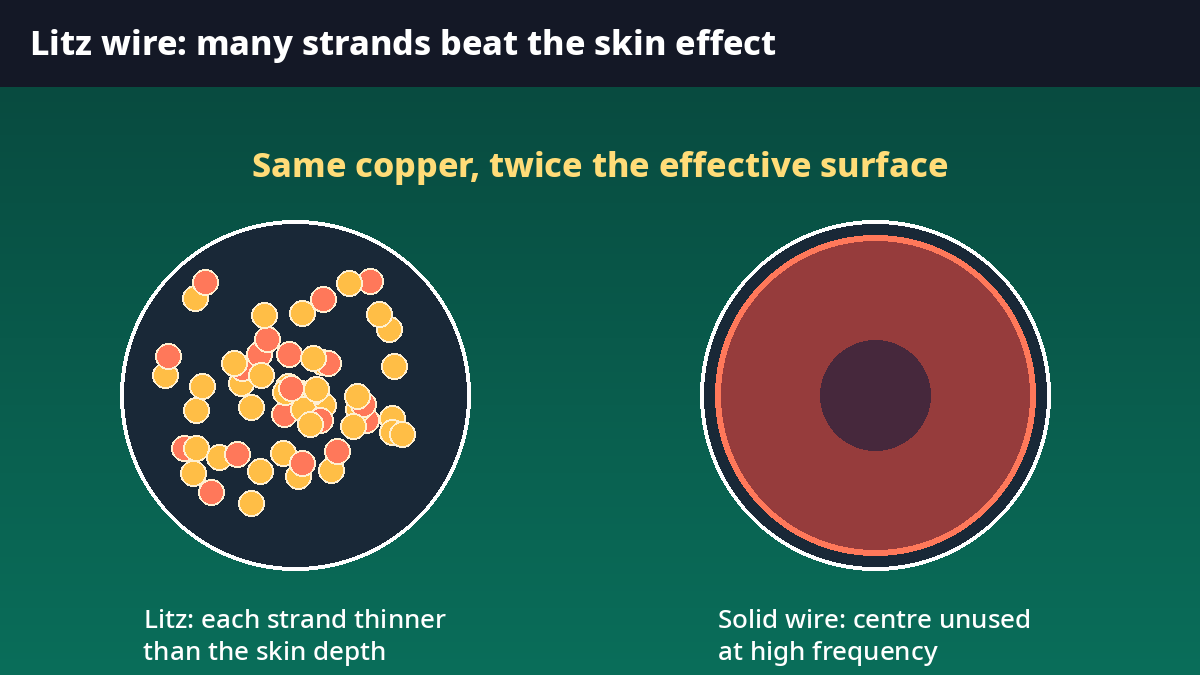
Choosing the strand size
The design rule follows directly from skin depth. A strand should be comfortably thinner than the skin depth at the operating frequency, ideally around half of it. At 20 kHz, where copper's skin depth is roughly half a millimetre, strands of 0.1 to 0.2 mm are typical. At 500 kHz, strands may be 0.05 mm or finer, and a bundle can contain thousands of them. Finer strands mean more enamel and more handling cost, so litz is specified only where the frequency justifies it.
Where litz wire earns its keep
The classic applications sit between a few kilohertz and a couple of megahertz: switch-mode power supply transformers and chokes, induction heating and cooking coils, wireless power transfer pads, RFID and NFC antennas, and the transmitters of medical and scientific radio-frequency equipment. Below the kilohertz range ordinary wire is usually fine; far above a few megahertz other constructions take over.
The compromises
Litz is not free lunch. The enamel and the air between strands mean a litz bundle carries less copper per square millimetre than a solid wire of the same diameter, so DC resistance is worse for the same outer size. Termination needs care too: the enamel on every strand must be removed, usually by a solder pot or hot-air stripping, before the bundle can be tinned as one. And because the weaving pattern matters, a cheap bundle with poor transposition can perform little better than parallel strands. Specified well, though, litz wire remains the most practical way to make a winding behave at 100 kHz the way it behaves at DC.