
Slip: the small gap in speed that makes an induction motor work
The most common electric motor in the world has no brushes, no magnets and no electrical connection to its rotor at all. The squirrel-cage induction motor runs because its rotor is always chasing a magnetic field it can never quite catch. The difference in speed, called slip, is not a flaw. It is the mechanism that makes the motor produce torque.
The rotating field
The stator of a three-phase induction motor carries three sets of windings spaced around the bore, fed by three-phase current. Together they produce a magnetic field that rotates smoothly around the stator at the synchronous speed: for a four-pole motor on a 50 Hz supply, exactly 1,500 revolutions per minute. The rotor is a cylinder of aluminium or copper bars joined by end rings, the squirrel cage, sitting inside that rotating field.
Why the rotor must lag
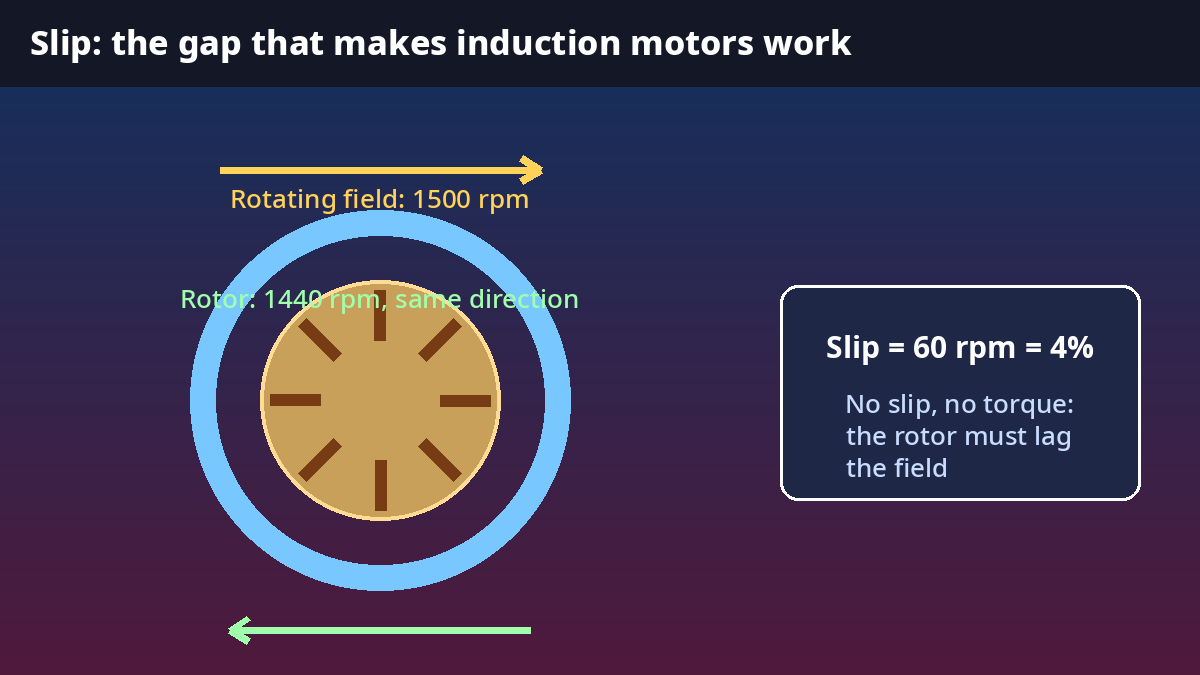
If the rotor ever turned at exactly synchronous speed, it would be travelling with the field, not through it. There would be no relative motion, no changing flux linking the cage bars, no induced voltage, no rotor current and no torque. Induction requires the field to cut the conductors. So the motor settles at a speed slightly below synchronous, where the difference is just large enough to induce the rotor current that the load demands. At full load this slip is typically only a few percent; a four-pole, 50 Hz motor nameplated at 1,440 rpm is slipping by 60 rpm, or 4 percent.
Slip as a load gauge
Slip rises with load, which makes speed a rough built-in load indicator. An unloaded motor slips by almost nothing and draws little more than magnetising current. Load it and the rotor slows slightly, slip increases, rotor current and torque rise to match. Maintenance engineers listen for this: a motor running noticeably slower and hotter than its nameplate suggests is telling you it is working harder than intended, or that something in the drive train is binding.
The starting problem
At the instant of switch-on, the rotor is stationary and slip is 100 percent. The induced rotor current is enormous, and the supply sees a starting current typically five to seven times the motor's rated full-load current for a few seconds. That surge is why large motors dim the lights when they start, and why star-delta starters, soft starters and variable-frequency drives exist: all of them are strategies for bringing the rotor up to speed without demanding the full inrush. Once near synchronous speed, slip settles to its few percent and the current falls to the running value.
Designing around slip
Rotor bar shape and material tune the trade-off. Deep or specially shaped bars exploit skin effect in the rotor itself to present high resistance at starting, when the rotor frequency is high, and low resistance at running, when it is low. The result is healthy starting torque without ruinous running losses. The same physics that limits the rotor explains the whole character of the machine: simple, rugged, self-adjusting, and always a step behind its own magnetic field.