
Test equipment for coil winding: from wire to finished coil
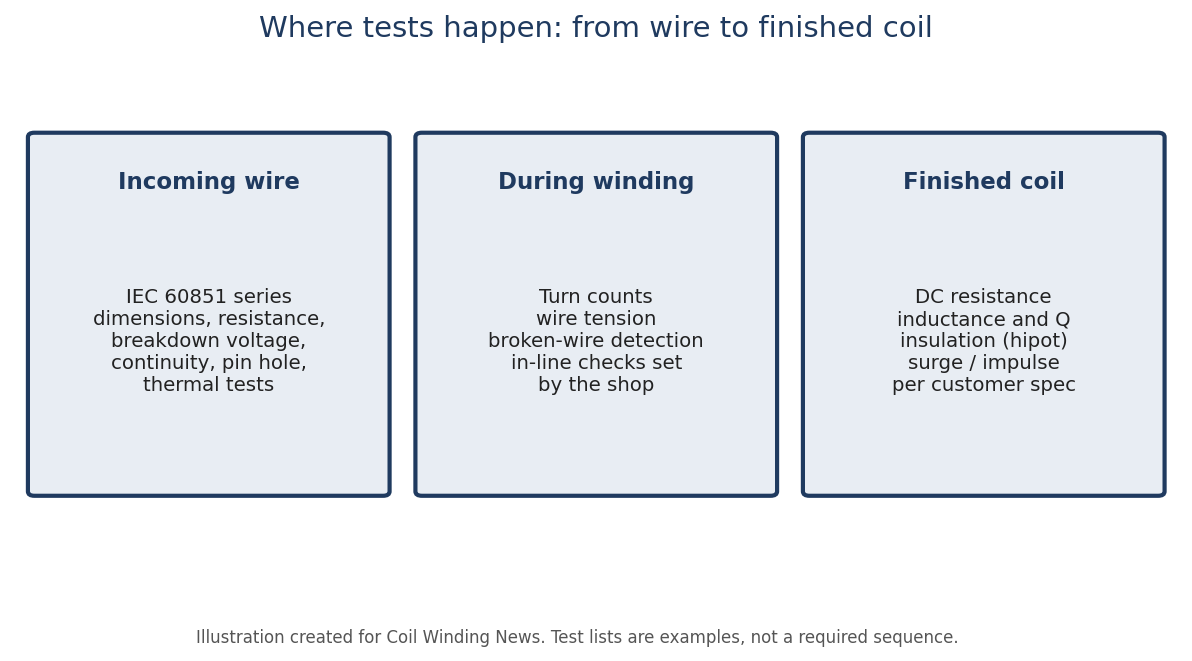
A coil can look perfect and still fail. A scratch in the enamel, a wrong turn count or a weak spot between turns shows up only when someone tests for it. Testing happens at three points: on the wire, during winding, and on the finished coil.
Testing the wire
The IEC 60851 series sets test methods for winding wire. Part 1 gives general notes and definitions. Part 2 covers dimensions. Part 5 covers electrical properties: resistance, breakdown voltage, continuity of insulation, dissipation factor and pin hole. Part 6 covers thermal properties: heat shock, cut-through, temperature index and loss of mass (the tests the IEC lists for IEC 60851-6:2012).
Part 5 has just changed. IEC 60851-5:2026 was published on 13 August 2026. It is the fifth edition and replaces the 2008 fourth edition with its two amendments. It widens the conductor size range for the loads used in the cylinder method of breakdown voltage testing, and adds a subclause on in-line continuity testing of rectangular wire, marked as under consideration. Shops that cite the older edition in purchase specifications may want to check which edition they mean.
Checks during winding
Winding machines count turns, control tension and can stop on a broken wire. Some lines add in-line checks. What is checked and how is set by the shop and the customer, not by one standard. A turn counter that drifts is as much a test equipment problem as a bad meter.
Testing the finished coil
Common checks on a finished coil include:
- DC resistance, which can show a wrong wire size, an open circuit or a poor joint. It is a check on the conductor. It is not a test of the insulation between turns.
- Inductance and Q, measured with an LCR meter or impedance analyzer. The result depends on test frequency and level, so a figure is only meaningful with its test conditions.
- Insulation withstand, often called a hipot test, and insulation resistance tests. These check insulation to ground or between windings. A Megger/EASA presentation on motor testing says insulation resistance, polarization index and step hipot tests can detect problems to ground, while an impulse (surge) test can find weak insulation between turns, open coils and reverse connections.
- Surge or impulse testing, which applies fast voltage pulses to find weak turn-to-turn insulation. IEEE 522 is the guide for testing turn insulation of form-wound stator coils.
For surge testing, IEC 60034-15:2025 is a useful reference. It covers AC machines with form-wound stator coils connected to a standard grid supply, and sets test procedures and voltages for sample coils and for routine tests on coils mounted in the stator core. The 2025 fourth edition replaced the 2009 edition. It aligns test levels with IEEE Std 522, adds an enhanced surge withstand level, and adds the option to test up to breakdown. It excludes converter-fed machines, and states that it is not intended for complete windings, because it is difficult to determine when the turn insulation has failed.
For small high-frequency inductors, IEC 62024-1:2024 describes measuring inductance, Q factor, impedance and resonance frequency with a network analyzer.
Conditions matter
IEC 60851-1:2021 revised its atmospheric test conditions and added remarks on test frequency and test management, a reminder that the same sample can give different results under different conditions. Good practice is to record the instrument, the frequency, the level and the temperature with every result, and to keep instruments in calibration.
What to ask a supplier
- Which tests are run on every coil and which are sampled?
- Which standard or customer method applies, and which edition?
- What are the pass limits, and are results recorded?
Standards information was checked on the IEC webstore on 25 November 2026. This article describes standards scope and general practice and does not recommend any instrument or claim compliance by any product. The diagram was created for Coil Winding News.
Sources: Megger presentation "Shortcomings of Low Voltage Testing" (EASA), IEEE 522 guide listing. Standards: IEC 60851-5:2026, IEC 60851-1:2021, IEC 60851-2, IEC 60851-6:2012, IEC 60034-15:2025, IEC 62024-1:2024