
Winding tension: the quiet variable that decides whether a coil works
Watch a coil winding machine at work and attention goes to the spinning spindle and the traversing guide. Ask the operator what they are watching, though, and the answer is often something you cannot see: wire tension. Of all the process variables in a winding shop, tension is the one that quietly writes itself into every layer of the finished coil.
What tension controls
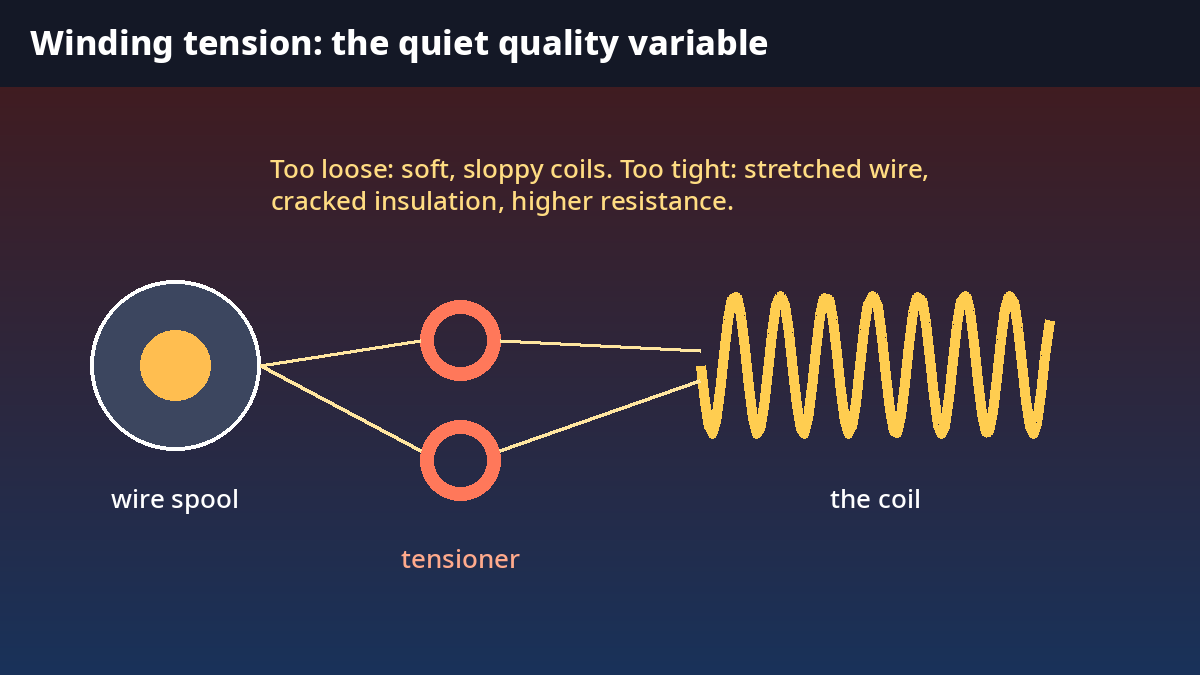
Each turn lands on the coil pulled to a set tightness, and that tightness determines how the turns sit. Adequate tension packs the winding densely and evenly, keeps the coil to its designed dimensions, and holds every turn immobile against vibration for the product's life. Too little tension gives a soft, loose coil: oversized, prone to turns shifting under vibration, and microphonic in sensitive circuits. Too much tension stretches the wire, and stretched wire necks down, raising its resistance; in the extreme the enamel cracks or the wire snaps mid-wind, scrapping the part or, worse, leaving a weakened joint hidden inside.
Why constant is harder than it sounds
The wire does not arrive at a steady pull. A full supply reel pays off differently from a nearly empty one; the wire's own stiffness varies with diameter; the traversing guide accelerates and reverses at each layer edge; and rectangular or oddly shaped formers speed the wire up and slow it down within every single revolution. A tension setting that is correct at the start of a shift can be wrong by the end of the reel.
The tensioner's job
Between reel and spindle sits the tensioner, whose whole purpose is to deliver a constant pull regardless of what the supply does. Mechanical designs use felt or ceramic brakes and dancer arms that soak up transient changes. Magnetic particle and servo-driven tensioners close the loop electronically, measuring and adjusting many times per second, and can programme different tensions for different stages of the wind: firm for the main body, gentle for fine tap leads. Fine wire for relays and small transformers, measured in hundredths of a millimetre, lives or dies on the quality of this control.
Reading tension in the finished coil
Quality problems traced back to tension have recognisable signatures. A coil that measures over its design resistance suggests stretched, thinned wire. Bulging end turns and a winding that grew beyond the bobbin suggest too little. Cracked enamel showing up as failed surge or insulation tests can be over-tension at the guide pulleys, where the wire wraps and the stress concentrates. The fix is rarely a new number on a dial alone; it is checking the whole path, from reel condition to guide wear, because every contact point adds its own friction to the story.
A small dial, a large effect
Tension rarely appears on a drawing and almost never on a datasheet, yet it determines whether the coil that was designed is the coil that gets built. It is the kind of variable that separates shops that wind wire from shops that make windings.