
Hairpin windings: why electric-car motors swapped wire for copper bars
Strip down the traction motor of a modern electric car and the stator looks wrong to anyone raised on round magnet wire: instead of bundles of thin strands, each slot holds a neat stack of flat copper bars, bent like hairpins and welded at the ends. This is the hairpin winding, and its rapid takeover of EV traction is one of the biggest changes to hit winding practice in decades.
The fill-factor argument
Round wires in a slot leave gaps: the circles never tile, and enamel and air claim the rest. A well-made conventional winding fills perhaps 40 to 45 percent of the slot with copper. Rectangular bars stack like bricks, and hairpin windings reach fill factors around 70 to 80 percent. More copper in the same slot means lower resistance, lower losses and more current capacity; at the same power the motor shrinks, or at the same size it makes more torque. For a vehicle, where every kilogram and every percent of efficiency is range, that trade is decisive.
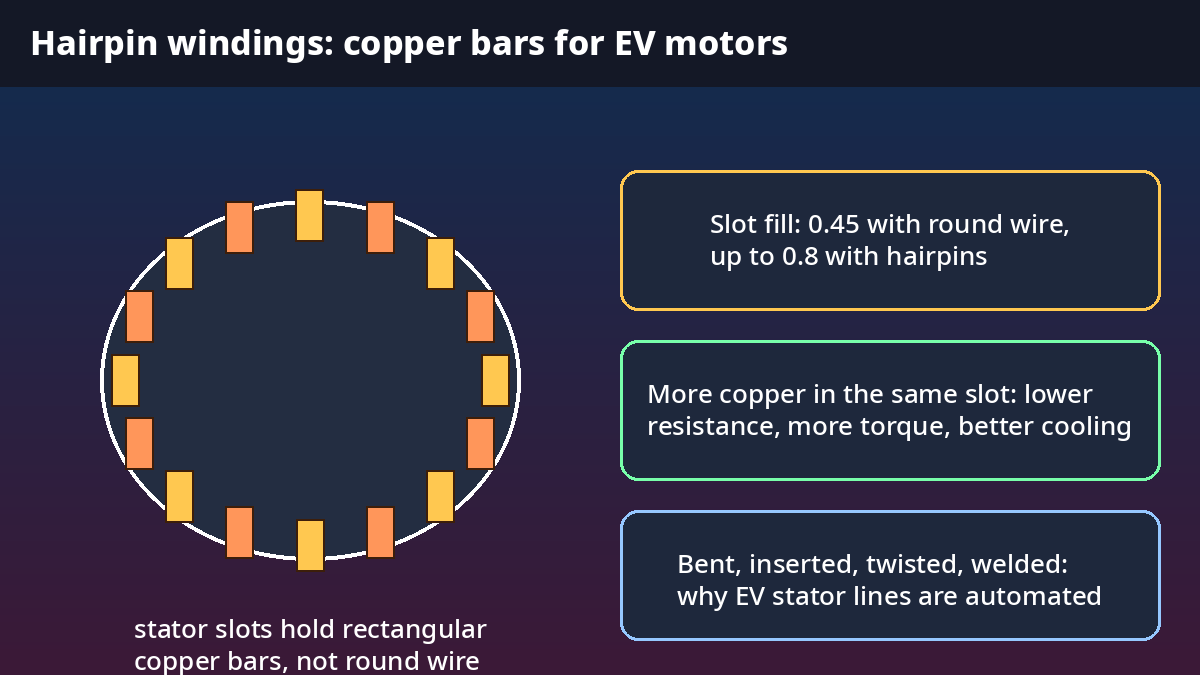
How a hairpin stator is built
The process inverts conventional winding. Flat enamelled copper strip is first formed into precise three-dimensional hairpin shapes on dedicated CNC formers. The pins are inserted into the stator slots, which are lined with insulation paper; the open ends are then twisted to interleave the layers, and finally the mating ends are welded, usually by laser, into the continuous circuit. There is no winding of wire through slots at all: the stator is assembled, not wound. The machines that form, insert, twist and weld the pins are among the most sophisticated in the industry, and the quality of each weld is verified individually.
The physics fights back
Flat bars are not a free win. At high speed the motor's electrical frequency climbs, and skin and proximity effects crowd current into part of each bar, eating into the efficiency gain; designers counter with more, thinner bars per slot and careful layer arrangement. The welds number in the hundreds per stator, each a potential defect, so end-of-line testing, including the surge and hipot checks familiar from conventional windings, is adapted to bar construction. And the tooling investment is heavy, which is why hairpin arrived first in high-volume EV programs.
Cooling as a bonus
The dense copper stack has a thermal benefit: heat travels along copper far better than through the air pockets of a random winding, so the bars conduct losses out of the slot efficiently. Combined with oil-spray cooling of the end windings, now common in EV drives, hairpin stators sustain power densities that round-wire designs struggle to cool at all.
Where it spreads next
From premium EVs the technique is cascading into mainstream models, commercial vehicles and performance hybrids, and variants like flat-wire wave windings address some of its tooling cost. The deeper significance for the winding industry is conceptual: a century of optimising how wire is pulled through slots has begun to give way, in the highest-volume motor market of the coming decades, to forming, placing and joining copper. The stator remains a coil; only the verb has changed.