
Surge testing: the split-second exam that catches weak turn insulation
Some winding faults hide from every steady-state test. A turn that barely touches its neighbour passes a resistance check, passes a megohmmeter, passes a hipot to ground, and then fails in service within weeks. The instrument built to expose exactly this is the surge tester, and its exam lasts microseconds.
The ringing winding
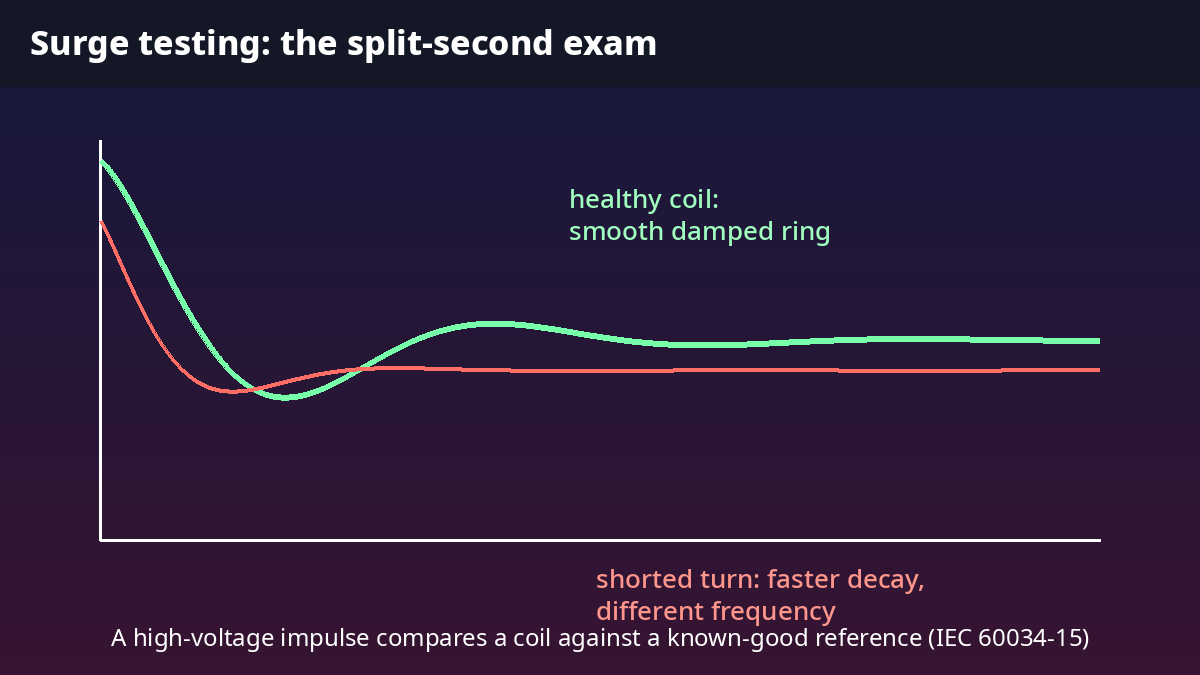
A coil is not just inductance; every turn couples capacitively to its neighbours, so a winding is a distributed network of inductance and capacitance with a natural resonant frequency. A surge tester exploits that. It discharges a capacitor into the winding as a fast, high-voltage pulse, with a rise time of a fraction of a microsecond, and records what comes back: the voltage oscillating at the winding's natural frequency and decaying as the energy dissipates. That decaying ring is the signature.
Now picture a shorted turn. It behaves like a one-turn secondary on a transformer: the pulse induces a heavy circulating current in the shorted loop, which sucks energy out of the oscillation and detunes the network. The ring damps faster and shifts in frequency. Comparing the trace against a known-good winding, or between two phases of the same machine, exposes the fault immediately: the sick phase's waveform collapses while the healthy one sings.
What the standards say
For form-wound stator coils, impulse voltage testing is standardised in IEC 60034-15, which sets the impulse levels sample coils must withstand and how routine tests on coils in the core are performed. The test voltages scale with the machine's rated voltage, with the intent of proving the turn insulation against the fast transients the grid, or a drive, will throw at it in service. Random-wound low-voltage motors get their own, related practice in the repair and manufacturing standards.
Why it leads the test sequence
Surge testing sits early in the production and repair sequence for a practical reason: it finds the fault while finding it is still cheap. A turn fault caught at the test bench costs a rewind of one coil; the same fault at a customer site costs a burnt stator, freight and goodwill. It pairs naturally with the resistance balance, hipot and partial discharge checks described in our test equipment overview, each catching what the others cannot.
Drive-era relevance
The test has grown more important, not less, in the age of variable-frequency drives. The fast voltage edges a modern inverter produces impose exactly the kind of turn-to-turn stress a surge test simulates, so inverter-duty verification leans on it. A winding that passes its surge exam is certified for the harshest half-microsecond its working life will offer, one pulse at a time.