
Partial discharge: hearing the tiny sparks that hollow out motor insulation
A high-voltage stator winding rarely fails without warning. Long before the insulation lets go, it is usually talking: tiny electrical sparks, far too small to bridge the insulation, flickering inside microscopic voids in the winding's own structure. Listening to those sparks, the measurement known as partial discharge testing, has become one of the main ways utilities and industry judge the health of large motors and generators.
What a partial discharge is
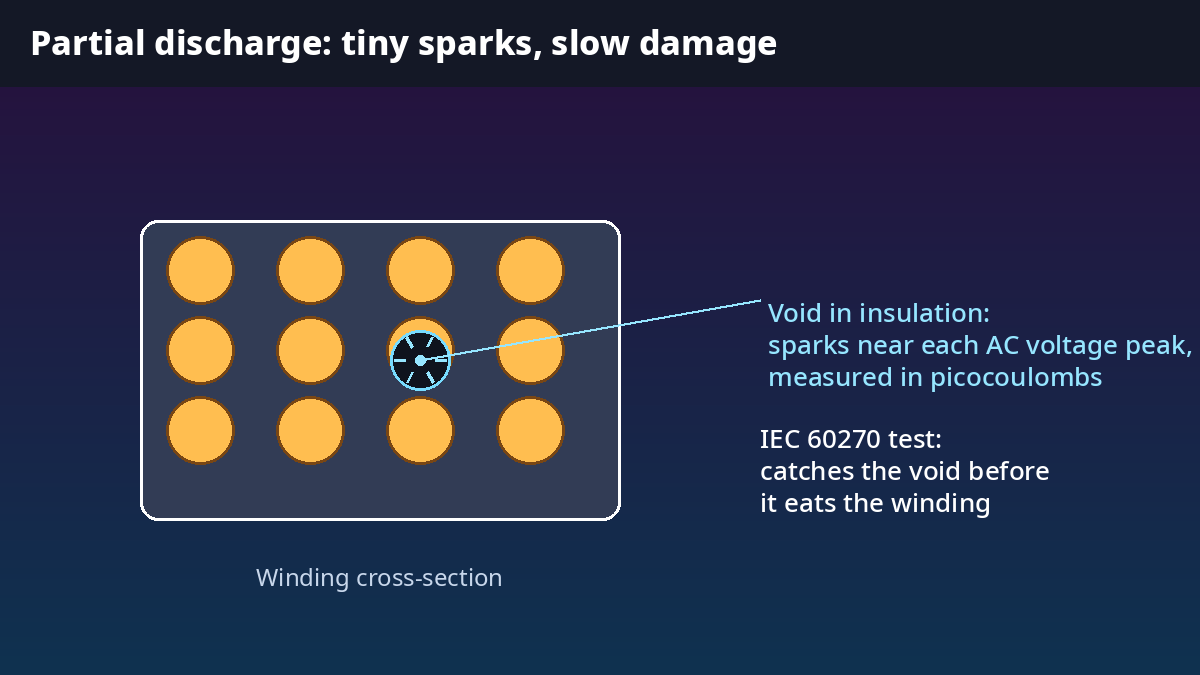
High-voltage groundwall insulation is built in layers: mica tapes, resin, glass backing. Manufacturing and aging leave small gas-filled voids inside or at the surface of that stack. Gas has a much lower dielectric strength than the solid around it, so when the winding is energised the electric stress inside a void can exceed what the gas can stand. The void sparks. The spark does not cross the whole insulation, which is why it is only a partial discharge, but it does erode the walls of the void a little at a time, carbonising and pitting the resin. Given enough years, the void grows, the discharges intensify, and the insulation's remaining life shortens accordingly.
How it is measured
Each discharge is a fast current pulse, and the classical measurement, standardised in IEC 60270, integrates those pulses and reports an apparent charge in picocoulombs. The detector listens in a radio-frequency band, typically somewhere between 50 kHz and 1 MHz, and calibration is done by injecting a known charge. Offline tests energise the winding with an external supply; online systems couple sensors permanently to the machine's terminals or bushing taps and watch while it runs. Online trending is where the real value sits: a single reading says little, but a level that doubles over a season is a winding asking for attention.
Reading the pattern
PD analysis goes beyond counting. The distribution of discharges across the AC phase, plotted as the familiar phase-resolved pattern, separates internal void discharge from slot discharge at the core surface, corona at end-winding stress grading, and plain electrical noise. Each source has a signature. This is why PD testing is as much interpretation as measurement, and why experience and databases of comparable machines matter; the standards themselves note that picocoulomb levels are relative indicators among similar machines rather than absolute pass marks.
Where it fits in maintenance
For large form-wound machines, PD trending sits alongside the other checks covered in our guides to winding test equipment and surge testing: insulation resistance and polarisation index for moisture and contamination, tan delta for general aging, PD for the local erosion those bulk tests miss. Caught early, the response can be as modest as cleaning and re-varnishing end windings; caught late, it is a rewind.
The quiet payoff
An unplanned outage of a large motor or generator costs orders of magnitude more than the monitoring that would have predicted it. Partial discharge measurement earns its place by turning an invisible, years-long erosion process into a trend line that maintenance can schedule around.