
Wireless charging: how two coils move power through thin air
Set a phone on a charging pad and a few millimetres of glass, plastic and air separate two copper spirals that, for the duration of the charge, become a transformer. Wireless power transfer is coil physics at its most direct: one winding generates an alternating magnetic field, the other collects it, and the gap between them is simply the core that is not there.
A transformer with an air core
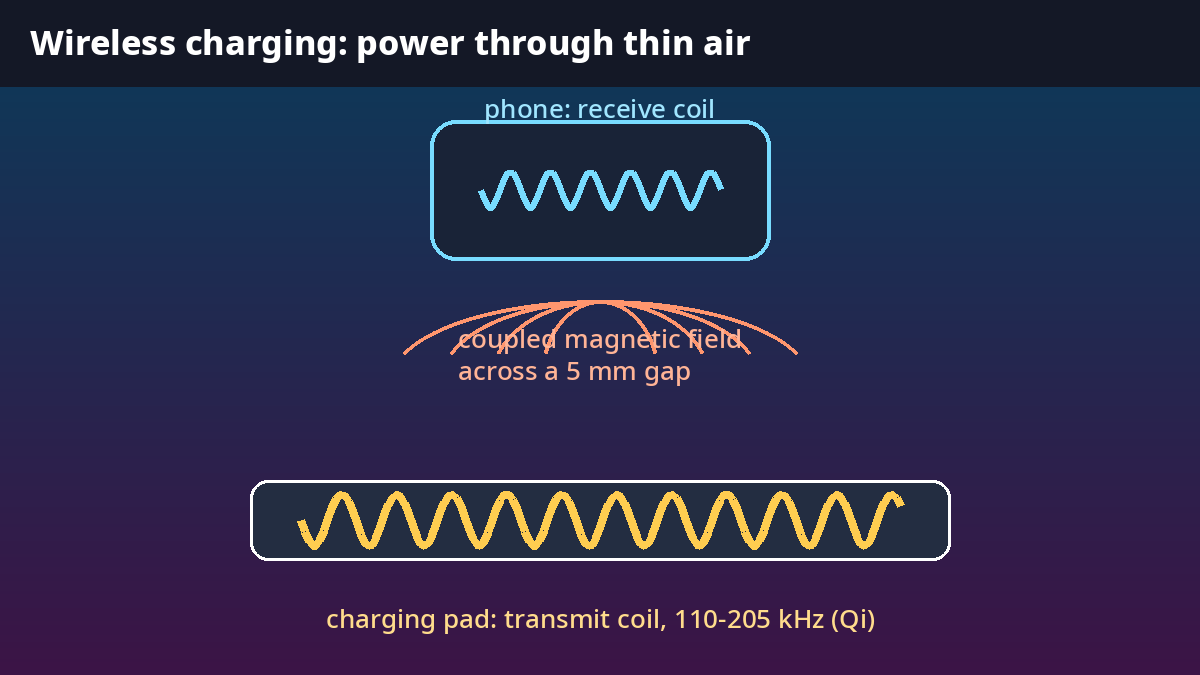
The pad's transmit coil is driven by a high-frequency inverter; the dominant consumer standard, Qi, works in the low hundreds of kilohertz, roughly the 110 to 205 kHz band for baseline power transfer. That frequency is a compromise: high enough that the coils can be small and thin, low enough that losses and electronics stay manageable. The phone's receive coil sits in that field and has a voltage induced in it, which is rectified and regulated to charge the battery.
Unlike a normal transformer, there is no iron guiding the flux, so most of the transmit field never reaches the receiver. Designers speak of loose coupling: only a fraction of the field lines link both coils, and the fraction falls off steeply with distance and misalignment. This is why a phone slightly off-centre on a pad charges slowly or not at all.
Resonance does the heavy lifting
Raw loose coupling would deliver pitiful efficiency. The fix is resonance: both coils are paired with capacitors to form tuned circuits at the drive frequency. Resonance builds up large circulating currents in the coils for a modest input, compensating for the weak coupling and pushing practical efficiencies into the same territory as a cable for phone-scale power. The winding details matter accordingly: pad coils are usually litz wire spirals to keep AC resistance down at a hundred-plus kilohertz, bonded to a ferrite sheet that shapes the field toward the phone and shields the electronics behind.
Talking across the gap
The link carries data as well as power. The receiver modulates its own load, which the transmitter senses as small changes in coil current, and that back-channel is how the phone asks for more or less power, identifies itself and says stop when the battery is full. The same signalling detects foreign objects: a coin or key in the field would be heated by eddy currents, so the pad measures its losses and refuses to transfer power when the numbers look wrong.
Beyond phones
The same principle scales. Electric toothbrushes and kitchen appliances charge through sealed housings for waterproofing. Medical implants receive power through skin. And electric vehicle charging pads scale the coils to metres across and kilowatts of throughput, with alignment aids and guidance to keep efficiency respectable. Each step up in power leans harder on the same fundamentals: coil geometry, resonance, and the eternal trade between gap size and coupling.
The coil at the centre
Wireless charging feels like a software-era convenience, but it is a winding-shop technology. The product is a pair of precision coils, and the difference between a good pad and a warm disappointment is written in strands, turns and ferrite.