
Five ways windings fail, and what each one is trying to tell you
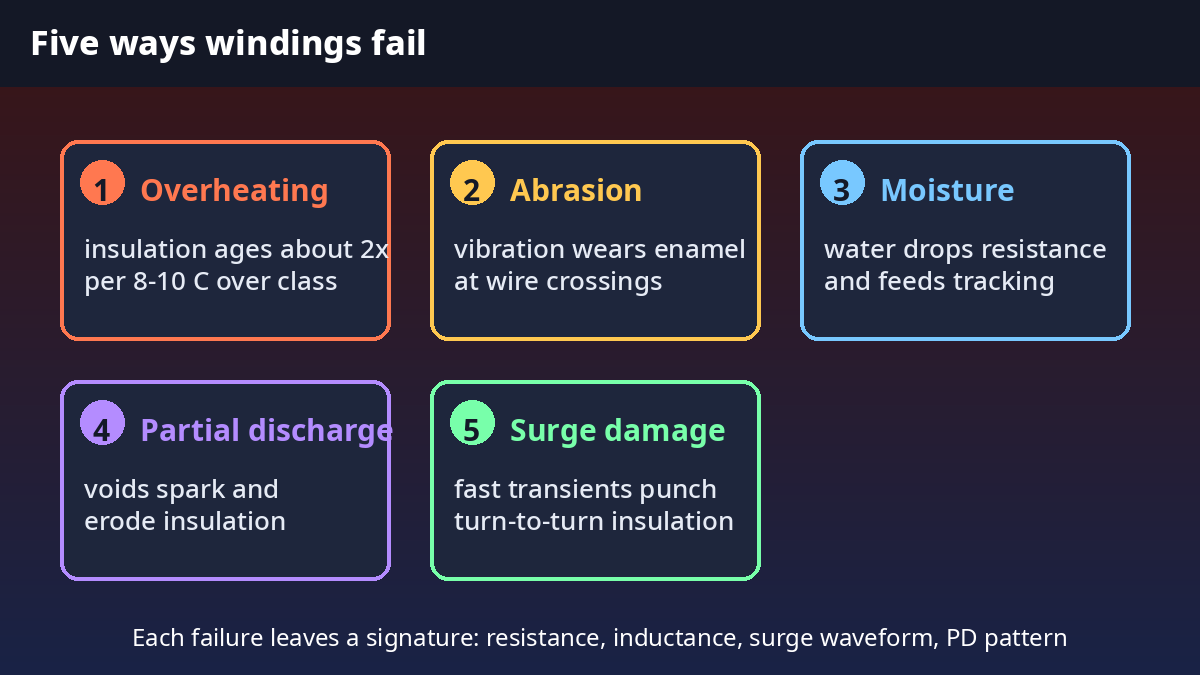
When a motor or transformer comes back burnt, the failure report often stops at "insulation breakdown". That is a description of the corpse, not the cause. Winding failures follow a handful of recurring patterns, and each pattern has a cause worth fixing, because a rewind that reinstalls the original problem is a failure waiting for its second act.
1. Thermal aging
Heat is the steady killer. Every degree above the insulation's thermal class spends the winding's life faster, roughly halving it per 10 degrees C. The evidence is general and even: enamel darkened and brittle throughout the slot, resin powdery, the whole winding uniformly cooked. The causes are the usual suspects: chronic overload, blocked cooling, high ambient, or a motor running on a drive it was never rated for. The fix is in the application, not the rewind.
2. Contamination and moisture
Oil, dust, conductive particles and water bridge creepage paths and wick into the insulation. The signatures are tracking marks, carbonised trails across surfaces, and corrosion at connections. Open motors in dirty plants and inadequately sealed machines outdoors are the classic victims. Insulation resistance and polarisation index tests catch this family early, which is why they anchor every maintenance round.
3. Vibration and mechanical wear
A winding that moves, even microscopically, is wearing. Loose slot wedges, inadequate impregnation or a coil that was under-tensioned at winding let conductors fret against each other and the core until enamel or groundwall wears through. The evidence is local: bright polished spots, dust from worn insulation, a failure at a specific slot exit. Two-pole motors, with their twice-line-frequency magnetic pull, are notorious. The answer is mechanical: proper wedging, varnish that actually penetrates, and braced end windings.
4. Voltage stress and surges
Lightning, switching transients and the steep wavefronts of modern variable-frequency drives all concentrate voltage stress on the first turns of a winding. Turn-to-turn insulation there is thin by design, and repeated fast spikes erode it until a turn shorts; the shorted turn then acts as a single-turn secondary, circulating enormous current in a small loop and burning out locally. Drive-fed motors need inverter-duty magnet wire and, often, output filters, exactly the stress surge testing simulates.
5. Manufacturing defects
The last family was born in the winding shop: crossed turns, enamel scraped at a guide, a brazed joint left brittle, wrong turn count, contamination under the varnish. These failures cluster early in life, which is why routine surge, resistance and hipot tests at the end of the line earn their keep. Partial discharge and surge comparison catch the weak spots before the customer does.
Reading the evidence
The craft of failure analysis is matching the pattern to the family: uniform cooking says heat, trails say contamination, local wear says vibration, entry-coil burns say surges, and early random failures say workmanship. Get the family right and the repair can address the cause; get it wrong and the same motor returns, expensively, to the same bench.